


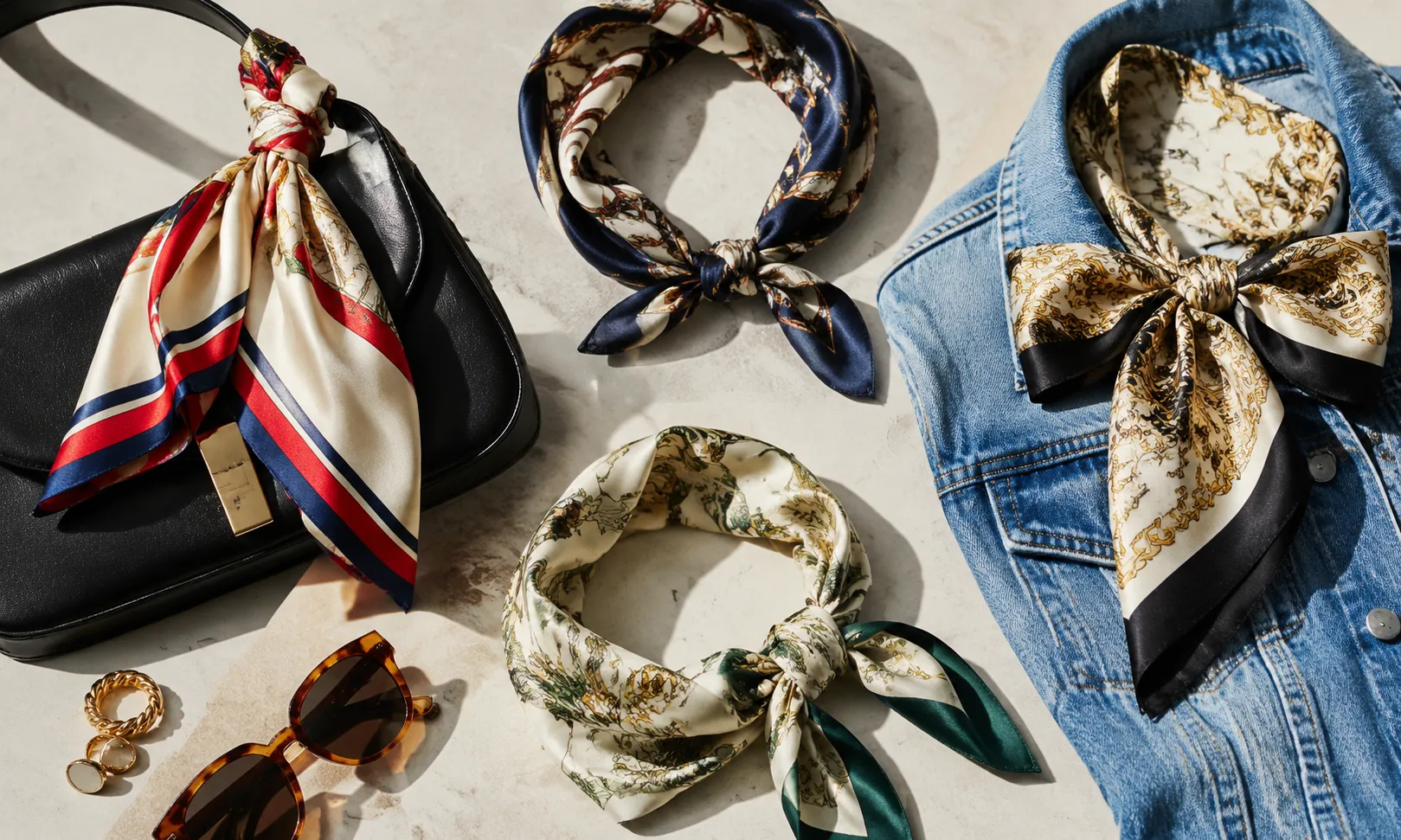

There’s a particular kind of object that never quite leaves the cultural imagination it just waits. The silk scarf is one of them. It has spent decades cycling through the wardrobes of old-money heiresses, downtown artists, flight attendants, and French grandmothers, absorbing meaning with every incarnation. Right now, in a fashion moment that prizes texture, individuality, and a certain studied nonchalance, the silk scarf is back not as a revival, but as something that never really needed reviving.
The question isn’t whether to wear one. It’s how to wear one without looking like you tried too hard, or worse, like you’re borrowing someone else’s aesthetic from1987. What follows are three genuinely unexpected approaches not the fold-it-into-a-ponytail tip you’ve already seen on every style blog since 2019, but angles that require a little more thought, and reward you with a look that feels entirely your own.
Tie It to Something That Isn’t You
The most liberating shift in how people are wearing silk scarves this season has nothing to do with the body at all. Instead of thinking about where it lands on your neck or wrist, try displacing the scarf entirely onto an object.
A tote bag with a silk scarf knotted at the handle changes its entire register. What was a utilitarian carry-all becomes something personal, a little whimsical, a little European. The weight of a quality silk moves differently than polyester or cotton when it catches air as you walk, and that movement is part of the appeal. You’re not just accessorizing a bag; you’re adding kinetics to a static object.
The same logic applies to a hat brim, a bicycle basket, or even thestrap of a camera. There’s something deeply satisfying about this approach because it sidesteps the anxiety of “does this work with my outfit” entirely. The scarf becomes part of the environment around you rather than a statement about your silhouette.
What you’re looking for in terms of fabric weight matters here. A lighter habotai silk will flutter and billow. A heavier charmeuse will drape in long, sensuous folds. Neither is wrong, but they tell different stories. The flutter reads as playful and spontaneous; the drape reads as deliberate and refined. Knowing which story you want to tell is half the decision.
One detail worth considering: color. When the scarf is on your body, it needs to relate to the palette of your clothing. When it’s on an object, it can do almost anything a mustard-yellow Hermès-style scarf on a bone-white tote creates a contrast that’s graphic rather than fashionable, which is often more interesting.
Wear It Where Structure Meets Softness
The second approach requires thinking about architecture. Not buildings garment construction. The places where a garment’s structure is most visible, most engineered, are exactly where a silk scarf can introduce the most productive tension.
The lapel of a blazer is one of these places. Instead of a traditional pocket square or a brooch, try looping a narrow silk scarf through the buttonhole or draping it across one lapel and tucking the tail into the breast pocket. The contrast between the stiff, woven construction of a well-tailored jacket and the fluid, almost liquid quality of silk creates a kind of visual conversation that neither element could have on its own.
This technique works especially well with menswear-influenced pieces oversize blazers, structuredcoats, double-breasted jackets. The more architectural the garment, the more the softness of the silk registers as intentional rather than accidental. And because you’re working with a small surface area, an intricate printed scarf doesn’t compete with the rest of the look; it punctuates it.
There’s an art historical precedent for this that’s worth noting. The Dutch Golden Age painters were obsessed with the juxtaposition of hard and soft a lace collar against a black wool doublet, a silk ribbon against a leather glove. They understood that the eye finds pleasure in contrast, that softness becomes more beautiful next to rigidity and vice versa. Applying that same principle to a modern outfit isn’t pretentious. It’s perceptive.
You can push this further with knitwear. A chunky cable knit sweater has its own kind of texture and structure, and draping a smooth silk scarf across the shoulders like a stole letting it fall loosely rather than tying it creates a layering effect that feels contemporary and a little unexpected. The key is restraint. Let the scarf lie where gravity takes it.
Use It as a Focal Point Below the Waist
This is the one that genuinely surprises people, largely because almost every piece of scarf-styling advice in circulation focuses on the upper body. Neck, shoulders, wrists, hair the scarf rarely travels further south, and that’s exactly why it should.
Tied as a belt through trouser loops, a long silk scarf changes the proportions of an outfit in a way that a leather belt simply cannot. The fabric bunches and knots with organic imperfection; it falls unevenly; it moves when you move. It introduces an element of looseness to what is otherwise a structured garment, and that looseness is currently exactly the right cultural signal something between dressed and undressed, between intention and ease.
The trick is the tie itself. A simple square knot pulled slightly off-center tends to work better than a bow, which can read as overly precious. Let the tails hang at different lengths if possible. The asymmetry is not a mistake; it’s the point.
For skirts, the approach shifts. A wide silk scarf folded lengthwise and wrapped around the waist as an overskirt tied at the hip, with the excess fabric cascading to one side is something that’s been appearing quietly in the work of several independent designers this season. It transforms a plain midi skirt into something more layered and complex without adding any bulk. The silk is lightweight enough to move with the skirt beneath it, creating a kind of double-layered motion that photographs beautifully and feels even better in person.
There’s also the trouser leg option, which sounds more unconventional than it actually looks when executed correctly. A narrow silk scarf tied just above the ankle outside the trouser, not tucked in is a callback to a very specific subcultural moment in late-70s downtown New York, but worn with contemporary proportions and fabrics, it reads as more personal than referential. It asks something of the person looking at it: a slight pause, a moment of recognition, and then, hopefully, a quiet appreciation that whoever put this outfit together was paying attention.
A Note on the Scarfs Themselves
All of this styling advice assumes that the scarf has some presence to it a print worth noticing, a weight worth feeling, a finish worth touching. The vintage market is an excellent place to find pieces that meet these criteria, particularly scarves from French and Italian houses from the 1960s through the 1980s, when print design on silk reached a kind of peak craftsmanship that most contemporary production hasn’t matched.
That said, newer scarves from smaller designers working with traditional printing methods woodblock, screen print, hand-rolled edges are increasingly available and often more interesting than archival pieces because they’re responding to right now rather than representing a fixed moment in the past.
What you’re really looking for is silk that has been treated with enough care in the making that wearing it becomes its own small pleasure not just a style choice, but a sensory one. The way quality silk warms to your body temperature, the way it holds a knot without slipping, the way a good print reveals new details in different light: these are the things that make the scarf worth the thought you put into wearing it.
The classic silk scarf has survived every trend cycle precisely because it resists the logic of trends. It doesn’t become dated; it becomes personal. And personal, in the end, is the most interesting thing any piece of clothing can be.


