



Why Transitional Weather Breaks Every Rule You Thought You Knew
There’s a particular kind of morning that catches people off guard every single year. You step outside in a coat, feel the sun on your face, and immediately regret your choice. By noon you’re carrying that coat over your arm. By 3 p.m., a wind rolls in and you wish you had it back. This is the rhythm of transitional weather that unruly stretch between seasons when the temperature can swing fifteen degrees before dinner.
Most people respond to this problem by either overdressing or underdressing, treating it like a coin flip. But layering isn’t guesswork. It’s a system, and once you understand the logic behind it, you stop gambling with your wardrobe every morning.
The Three-Layer Framework (and Why People Get It Wrong)
The foundation of smart layering rests on three distinct functional zones: a base layer that manages moisture, a middle layer that traps heat, and an outer layer that negotiates with the environment. Simple enough in theory. The problem is that most people collapse these categories together, wearing a single thick sweater and calling it a day, then suffering the consequences.
The base layer is the one most people skip entirely, especially in transitional weather when full-on winter gear seems excessive. This is a mistake. A well-chosen base layer something lightweight, breathable, and fitted close to the skin regulates your body temperature in both directions. It wicks sweat away when you’re warm, and keeps you from feelingclammy when the temperature drops. Cotton feels comfortable but holds moisture against your skin. Merino wool or synthetic performance fabrics are far better options, even under a regular outfit.
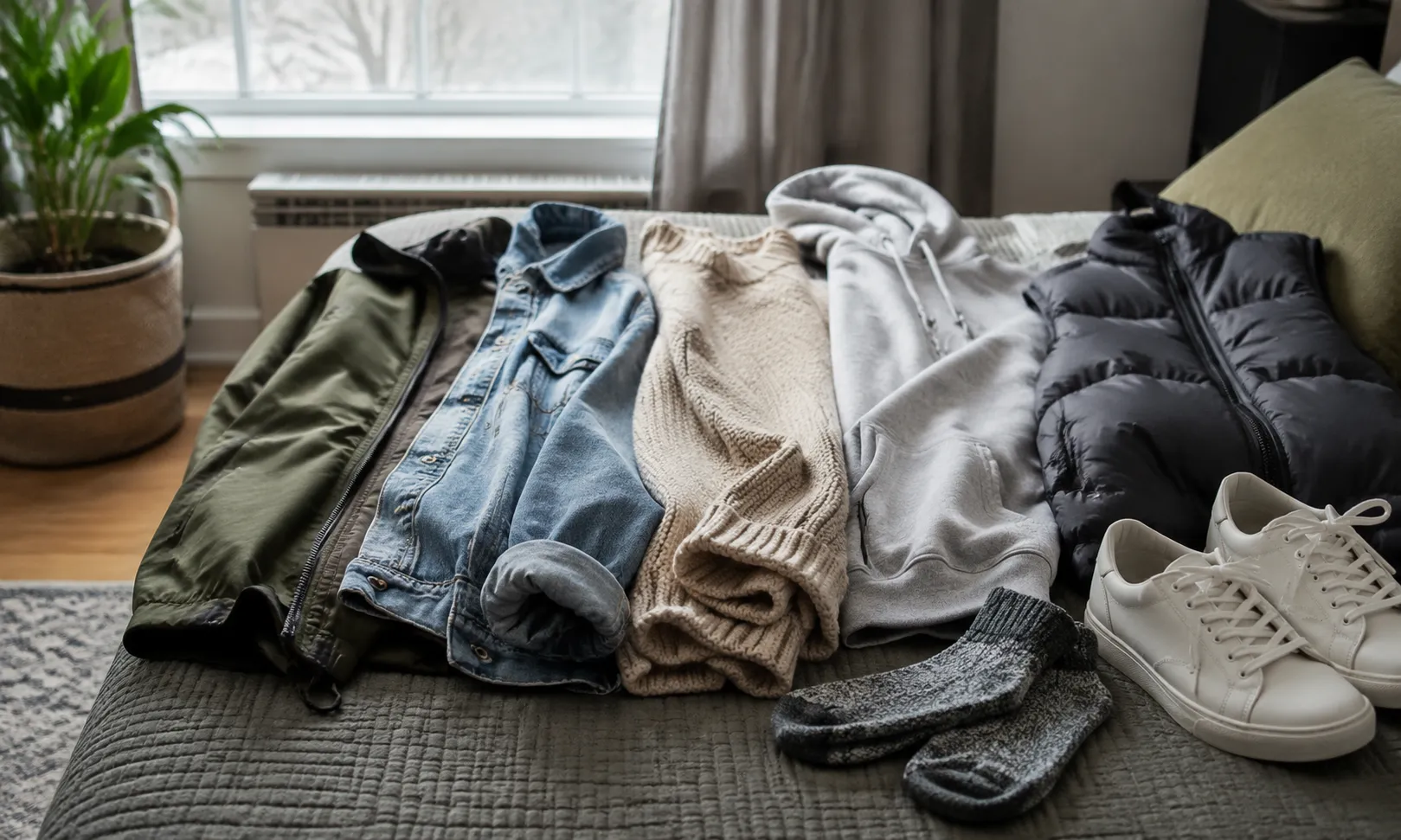
The middle layer is where most of the thermal work happens. A quilted vest, a lightweight fleece, a chunky knit cardigan each of these serves as an insulating buffer. The goal here is trapped air, which is what actually keeps you warm. Thickness alone doesn’t determine warmth; structure matters just as much. A well-constructed fleece can outperform a bulky sweater because of how it holds heat close to the body without adding weight.
The outer layer is your interface with weather itself. On a crisp October afternoon, this might just be an unlined denim jacket. On a blustery March morning, you might need something wind-resistant. The key property to look for is adaptability something you can remove easily and carry without it becoming a burden.
The Texture and Weight Equation
Here’s where layering becomes genuinely interesting, and where it crosses over from utility into style. Fabric weight and texture determine not just how warm you’ll be, but how the whole outfit reads visually. Pairing a lightweight turtleneck with a mid-weight blazer and a sleek trench coat creates visual coherence because each layer sits cleanly on top of the next without bunching or bulking at the shoulders.
The cardinal mistake is layering items with incompatible textures a thick cable-knit sweater under a fitted blazer, for instance. The sweater will win. The blazer will pull at the seams, bunch around the arms, and look uncomfortably strained. Instead, think of each layer as needing to be slightly leaner than the one on top of it. Your base sits slimmest, your mid-layer has a little more body, and your outer layer has the most structure or volume.
That said, intentional volume can absolutely work. An oversized coat over slim layers is a classic silhouette precisely because the contrast is deliberate. The logic is the same proportional harmony just expressed in reverse.
Reading the Forecast Like a Stylist, Not a Meteorologist
Weather apps give you numbers. Layering well requires translating those numbers into a decision about your body and your day. A high of 58°F means almost nothing on its own. But58°F with a 20mph wind, starting cloudy and clearing by afternoon, tells a much more specific story.
Wind dramatically affects perceived temperature a light jacket that feels perfect in still air can feel laughably inadequate when a breeze picks up. Humidity does the opposite kind of damage in autumn;55°F in dry air is a pleasant sweater day, but 55°F with high humidity can feel bone-cold. These are the variables that layering is actually designed to address, not just temperature.
Before getting dressed on an unpredictable day, it helps to think in three time blocks: morning, afternoon, and evening. What does each window demand? If morning is cold, afternoon warms up, and evening dips again, you want a system where you can shed a layer at noon and recover it at 6 p.m. without your outfit falling apart aesthetically in the process.
The Vest as an Underrated Transitional Weapon
Among all the pieces in a transitional wardrobe, the quilted or down vest is perhaps the most undervalued. It solves a specific problem beautifully: it insulates your core without restricting your arms or adding sleeve bulk. This matters on days when you need warmth but also need to move freely commuting, running errands, spending time outdoors in changing conditions.
A vest layers cleanly under almost any coat and doesn’t compete for sleeve space. Worn as the outermost layer, it pairs well with long-sleeve shirts or lightweight flannels on days that are cool but not cold. It adds warmth without the visual weight of a full jacket, which can be useful in the shoulder seasons when you’re not quite ready to commit to full outerwear.
What makes the vest particularly clever is its versatility across gender and aesthetic codes. A sleek puffer vest reads athletic. A tailored knit vest reads smart-casual. A barn-style vest reads rugged. The function is the same; only the context changes.
Color, Cohesion, and Not Looking Like You Got Dressed in the Dark
One reason people resist layering is the fear of looking chaotic like they pulled everything from the closet at once and hoped for the best. The antidote isn’t matching everything perfectly; it’s establishing a tonal anchor.
Pick one dominant color or tone that runs through at least two of your three layers. Everything else can vary. Navy chinos, a slate-grey pullover, and a navy overcoat create cohesion even if the exact shades don’t match precisely. The eye reads the tonal family and the outfit looks intentional. Throw a forest green mid-layer into that same palette and it either harmonizes or becomes the accent both are deliberate choices, not mistakes.
Patterns work similarly. If one layer has a pattern a plaid flannel, a striped sweater keep the others solid. The pattern needs visual breathing room, and stacking patterns without a clear hierarchy is where outfits start to feel confused rather than composed.
What to Actually Keep in Your Rotation
In practical terms, a well-functioning transitional wardrobe doesn’t require an overwhelming number of pieces. A few reliable base layers in neutral tones. Two or three mid-layer options that span the warmth spectrum a lighter cardigan for mild days, a fleece or quilted piece for colder mornings. One or two outer layers that cover different weather conditions: a structured coat for dry cold, something water-resistant for damp days.
The items that earn their place in a transitional wardrobe are the ones that genuinely work at both ends of the temperature spectrum. A merino crewneck is useful on a40°F morning and just as useful on a breezy 65°F afternoon. A cotton-lined denim jacket handles the mild shoulder-season days but won’t carry you through a cold snap. Knowing the operational range of each piece is what lets you build combinations with confidence rather than crossing your fingers.
Transitional weather is not, at its core, a fashion problem. It’s a comfort and practicality problem that happens to have aesthetic consequences. Solve the function first stay comfortable from morning through evening, stay prepared for what the day throws at you and the style tends to follow from the choices you’ve already made thoughtfully.


